Some cool stuff here:
Education: http://www.dellchallenge.org/discover/dewc/6
Health:
http://www.dellchallenge.org/discover/dewc/10
http://www.dellchallenge.org/discover/dewc/8
http://www.dellchallenge.org/discover/dewc/49
Myriam Mazzo is a teacher in the central Colombian city of Armenia, a rural town of about 300,000 people nestled in the mountains southwest of Bogotá. In her school’s single classroom, she teaches children of various ages and grade levels who work in small groups at their own pace. Rather than standing by a blackboard at the front of the class, Ms. Mazzo moves among them, serving as a guide more than an instructor.…
Ms. Mazzo has used this method of teaching, known as Escuela Nueva or “New School,” for 28 years after experience teaching in a traditional public school in Colombia. The method, developed by Clara Victoria (Vicky) Colbert de Arboleda in the 1970s, was designed specifically for teachers like Ms. Mazzo, teaching multiple grade levels in one classroom in rural communities.
…
“With Escuela Nueva, the student is a leader, no longer the shy kid in a traditional classroom,” Ms. Mazzo said in a telephone interview. “He’s not the one afraid to speak or share ideas, he is participative, democratic, knows how to share and work in teams, and — most importantly — he can work at his own pace, so he is motivated to come back after long absences.”
…
Escuela Nueva’s flexible program encourages dropout students to come back to school to study at their own pace and to take exams when they are ready.
“If a student learns faster, I can guide him and he can go even faster; and if a student has difficulties or has been away for a long while, he can be supported,” said Ms. Mazzo. “If a student is away due to illness or farmer parents who move around, when he comes back to school, he can follow his learning guides where he left off — so students are motivated, self-esteem stays high, and they never repeat grades.”
…
Between 2007 and 2009, the program taught 700,000 children in Colombia, and the model is now implemented in 20,000 schools across the country in both rural and poor urban areas. Escuela Nueva has now expanded internationally to 19 countries, including Brazil, the Philippines and India, benefiting more than five million underprivileged children.
…
The method transforms the conventional learning paradigm where the teacher is the only one talking and conveying information in a classroom. The idea is that students are placed in the center of the learning process. While the philosophy is not new, its application in a low-cost way in rural communities by Ms. Colbert’s team is revolutionary.
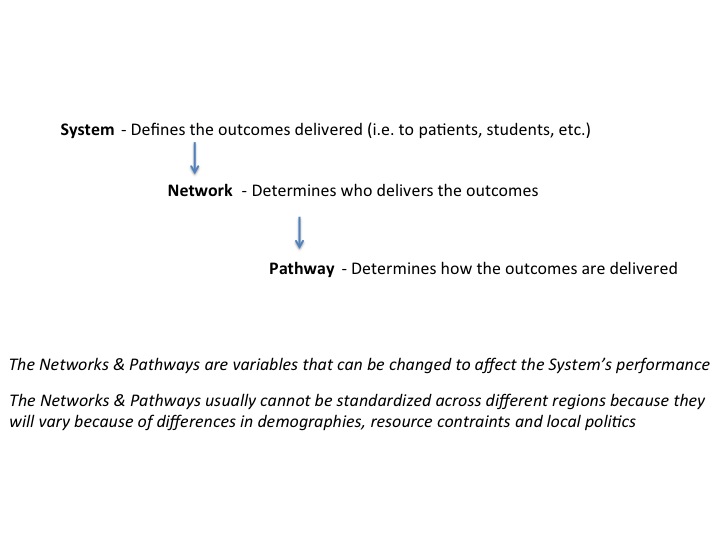
This is a diagram I created to summarize the work I do on Systems, Networks and Pathways with Sir Muir Gray. Our work focuses on education but I think this approach can be adapted for other areas too.
 anantjani.com